
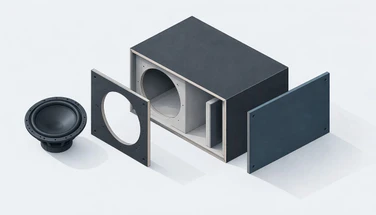
Posted by Cas on Nov 14th 2026
Custom Subwoofer Box Guide

A custom subwoofer box is an enclosure built to the exact net volume and port tuning your subwoofer calls for, and shaped to the space in your vehicle. A prefab box is a standard size that you fit around. The difference matters because the enclosure is half of the subwoofer’s sound: the same driver can sound tight, boomy or thin depending on the box. The best result comes from choosing the sub, the amp and the enclosure as one matched system, which is how we plan every build at Crystal Audio Solutions.
Need help planning your system? Visit.
TL;DR
- Pick the enclosure type by the sound you want: sealed for tight, accurate bass, ported for more output around the tuning frequency.
- Design to the subwoofer’s recommended net volume, then add the space taken up by the driver, port and bracing to get the outside size.
- Measure the maximum height, width and depth of your space, and confirm the finished box fits through the trunk opening or door.
- Use 3/4-inch MDF, glued and screwed joints, internal bracing and an airtight seal, then fasten the box to the vehicle.
- Match the sub, amp and box together before you buy, so the parts work as a system.
Table of Contents
- What makes a subwoofer box “custom”
- Sealed or ported: choose the sound first
- How big should a custom subwoofer box be
- Measure your space before you design anything
- Port dimensions and tuning for ported boxes
- Materials and construction that last
- Match the box to the amp and the rest of the system
- Where we fit in
- Our view on custom boxes
- FAQ
- Sources
What makes a subwoofer box “custom”
Three things separate a custom enclosure from an off-the-shelf one.
Built to the driver. Every subwoofer has a recommended air volume and, for ported designs, a port size and tuning frequency. A custom box is cut to those numbers instead of to a catalog size that is close enough. Too big or too small a box changes how the driver moves and how much power it can take.
Built to the vehicle. Trunks have wheel wells, sloped hatches and spare-tire cutouts. Trucks have space behind or under the seats. A custom box uses that dead space so you keep your cargo room, and the box can be shaped to a corner, a side panel or a under-seat cavity.
Built to the goal. A daily driver who wants fuller bass without losing the trunk wants a different box from a competition builder chasing maximum output at a single frequency. Custom lets you choose the tradeoff on purpose.
A prefab enclosure is still a reasonable fit for many daily setups when the dimensions work in your vehicle. Custom earns its cost when the space is awkward, when the driver has demanding specs, or when you want a particular sound.
Sealed or ported: choose the sound first
Before any measuring, decide on the enclosure type. The two main choices behave very differently.
Sealed boxes use the trapped air as a spring that controls the cone. According to a manufacturer’s technical paper on enclosure types, sealed designs give tight, accurate bass and roll off at 12 dB per octave. They are also more forgiving: they are smaller than ported boxes for the same driver and do not need a tuned port.
Ported boxes couple the sound from the back of the cone to the front through a vent. The same paper explains that this raises output around the tuning frequency, with a steeper 24 dB per octave roll-off below it. Ported boxes are popular for hip-hop and rap, need more airspace and call for a subsonic filter that keeps the driver from moving too far on notes below the tuning.

The numbers from a published analysis of ported enclosures show the tradeoff. In that example, adding a vent tuned to 35 Hz raised predicted output at 35 Hz from 105.6 dB SPL to 112.5 dB SPL, roughly a 7 dB gain. But at 15 Hz the sealed box produced 93.1 dB SPL against 85.5 dB SPL for the ported box. Ported gains output where it is tuned and gives some back far below that.
A simple way to choose:
| If you want | Lean toward |
|---|---|
| Tight, punchy bass for rock, jazz, acoustic and mixed listening | Sealed |
| Maximum volume for hip-hop, rap and electronic music | Ported |
| The smallest box you can get | Sealed |
| A box that tolerates a wide range of settings | Sealed |
| Loudness around one target frequency, such as for competition | Ported, tuned to that target |
The same paper also describes bandpass designs, which can send bass through a small opening into the cabin. They suit situations like a sedan with a steel package tray, and are more specialized than the first two.
If you are unsure, tell us the music you listen to, the vehicle and how much space you can give up. Our Build My System service starts from exactly those details.
How big should a custom subwoofer box be
The question “what is the right car subwoofer box size” has two answers: the air volume inside, and the outside dimensions you cut.
Start with net volume
Every subwoofer maker publishes a recommended enclosure volume, usually as a range for sealed and a figure for ported. Size trends are consistent. The manufacturer’s enclosure paper notes that a small sealed box gives tight, punchy bass with high power handling, while a larger sealed box plays deeper but handles power less well, and a very large sealed box starts to behave like an infinite baffle. In ported designs, small boxes must be tuned higher and handle less power, while large ported boxes play lower and louder.
Examples of driver specs show the scale. One 12-inch subwoofer’s installation manual lists an optimum vented enclosure of 1.79 cubic feet (50.7 liters) tuned to 45 Hz, with a 4-inch diameter port 9.3 inches long, and tells you to use a subsonic filter in vented designs. Your driver will have its own numbers, and those are the ones to build to.
Then add displacement to get gross volume
This is where homemade and rushed boxes go wrong. Net volume is the air the driver actually sees. The driver’s motor and basket, the port and the internal braces all take up room inside the box. A tutorial on enclosure sizing explains that you must add their combined displacement to the target net volume, or the box might not sound as good as it can.
The build guide puts the sequence in order: work out the enclosure size, subtract the displacement of the driver, braces and port from that volume, and only then finalize the driver choice. In practice:
- Take the recommended net volume from the subwoofer’s spec sheet.
- Add the driver’s displacement, the port’s displacement (ported boxes) and the bracing.
- The total is the gross internal volume.
- Add wall thickness on every side to get the outside dimensions.
Worked example: a sub calls for 1.25 cubic feet net. The driver displaces about 0.10, the bracing about 0.05 and the port about 0.07 (your own driver and port will differ). Gross internal volume is then about 1.47 cubic feet, before you add wall thickness to the outside. The custom box has to be built to that gross number, not to 1.25.
That is a lot of arithmetic with room for error, and a mistake only shows up once the box is built. Part of what we do before purchase is check that the subwoofer, amplifier and enclosure are compatible for your vehicle, so the volume and tuning you order are the ones the driver needs.
Measure your space before you design anything
A box that sounds right on paper is useless if it does not go in the vehicle. The tutorial from the same source gives a sound routine:
- Measure the maximum height, width and depth of the installation area with a good tape measure.
- Sketch the enclosure on paper before committing to dimensions.
- Avoid long round enclosures over 72 inches.
- Re-measure to confirm the finished box will fit through the trunk opening, not just into the trunk.
A few practical additions that come from how vehicles are laid out:
- Trunks: note the wheel wells, the trunk lid hinge arc, and whether the rear seats fold. Leave room for the lid to close and for the box to be strapped down.
- Hatchbacks and SUVs: measure the cargo floor and the height under the cargo cover, if you want to keep it.
- Trucks: check the space behind or under the seat, since depth there is often limited and the box may need an angled back.
- Cables and the port: leave room for the wire connections and for the port to breathe. A port that opens against a wall or a carpeted panel loses performance.
Write down the measurements with the vehicle’s year, make and model. Our Custom Speaker Pod Fit Guide shows the same measure-first thinking for pods, and it carries over to enclosures.
Port dimensions and tuning for ported boxes
If you chose ported, the port is the part to get right. Three things work together: the box volume, the port’s cross-section and its length.
A subwoofer manual from a major manufacturer states that tuning frequency can be adjusted by changing port length, and that larger boxes tend to be easier to tune to lower frequencies while medium and small boxes are easier to tune to higher ones.
The published analysis of ported enclosures adds why this matters. At the tuning frequency the vent’s output is in phase with the subwoofer, and the pressure inside the box reduces cone motion sharply, so near the tuning most of the sound comes from the vent, not the cone. Below the tuning that protection falls away, which is why ported systems need a subsonic filter, as the 12-inch manual states for maximum reliability and power handling.
What to decide:
- Tuning frequency: lower tuning gives deeper, smoother bass for mixed music. A higher tuning gives a punchier peak. Competition builders tune to the frequency they are chasing.
- Port shape: round, slot and aero ports can all work. What counts is the area and length the design calls for, and that the port fits inside the box with the bracing.
- Port length versus box depth: long ports may need to be folded or bent, and that changes the volume you have to account for.
Materials and construction that last
A custom box has to be rigid, airtight and secure. Flex wastes energy as panel vibration, and air leaks in a sealed box can change its behavior and cause audible noise.
Wood. The build guide calls for dense, heavy material: 3/4-inch (19 mm) MDF or high-density fiberboard, with 1/2-inch MDF acceptable for woofers 8 inches and smaller. The sizing tutorial breaks it down further: 3/4-inch MDF as the standard, 1/2- or 5/8-inch for boxes up to 1 cubic foot, and 1-inch with braces for boxes over 4 cubic feet.
Joints. The same tutorial recommends butt or 45-degree miter joints with carpenter’s glue and screws, and 1-inch corner bracing at every inside edge to get an airtight seal.
Bracing. Large panels are the weak point. Cross-braces and window braces stiffen them, but remember that each brace takes up air, which goes back into your displacement math.

Mounting in the vehicle. An unsecured box is a safety issue. A manufacturer’s installation manual says to fasten the enclosure to the vehicle frame or floorpan because a loose one can become a projectile in a collision. Use proper fasteners into solid structure or a strap system rated for the weight, and re-check them after the first few weeks of driving.
Finish. Carpet, vinyl, paint or a wrapped finish are cosmetic choices. The finish should not block the port or add thickness you did not allow for.
Match the box to the amp and the rest of the system
A perfect enclosure will not fix an undersized or mismatched amplifier. The box, the subwoofer’s power rating and impedance, and the amp have to agree, and the wiring and electrical system have to be able to deliver the current.
Two guides of ours cover those sides: the Amp and Subwoofer Matching Guide for power and impedance, and the Car Audio Wire Gauge Guide for the power and ground cable. If you are planning a larger upgrade, what to change first and how to plan it puts the subwoofer in order with the other changes.
Where we fit in
We sell subwoofers, amplifiers, subwoofer enclosures, speaker pods, wire, batteries and alternators, and we pair them to your vehicle and goals. Our approach is system-matched: you give us your vehicle details and what you want from the system, and we verify compatibility before purchase and provide build guidance from real installers. Bundle savings apply automatically, and flexible payment options are available. For specialty builds we offer custom quotes, and we also provide custom battery builds and recone services.
If you are planning a custom box, the shortest route is to start with Build My System and tell us the subwoofer, the vehicle and the sound you are after.

Browse our subwoofers, amplifiers and electrical parts to see the components that go together with your enclosure.
Our view on custom boxes
Most of the disappointing subwoofer installs we hear about are not bad subwoofers. They are good subwoofers in the wrong box, or on an amp that does not suit them.
That is why we start with the vehicle and the goal, not the product page. A daily driver who wants to keep the trunk and a competition builder chasing a number need different answers, and the right enclosure follows from that.
Our approach is to match the subwoofer, amp, enclosure and electrical parts as a system and check compatibility before you buy. Real installers answer the questions. If your build is unusual, we quote it as a custom job. And if the budget is the sticking point, flexible payment and automatic bundle savings are there to help you do it right the first time instead of in stages.
A custom box is worth it when everything around it is matched to it.
Colten
FAQ
How much does a custom subwoofer box cost?
Price depends on the size, the materials, the design and the finish, so there is no single figure. A larger ported box with bracing and a wrapped finish costs more than a small sealed box. Tell us the vehicle and the subwoofer and we can quote it with the rest of the system.
Is a sealed or ported custom enclosure better?
Neither is better in every case. Sealed gives tight, accurate bass in a smaller box, while ported gives more output around its tuning frequency and suits hip-hop and rap. Choose by the music you play and the space you have.
What size box does my car subwoofer need?
It needs the net volume the subwoofer’s spec sheet recommends, plus the room taken up by the driver, port and bracing, plus the wall thickness. The outside size must then fit your measured space and the trunk opening. Share the subwoofer model with us and we can check the numbers against your vehicle.
What wood is best for a subwoofer box?
Three-quarter-inch MDF is the standard choice for most enclosures, with 1/2-inch acceptable for woofers 8 inches and smaller and 1-inch with braces for very large boxes. Glue and screw every joint and brace the inside edges so the box stays airtight and rigid.
Do I need a subsonic filter with a ported box?
Yes. Ported designs let the cone move more on notes below the tuning frequency, and manufacturer manuals call for a subsonic filter to protect the driver and keep power handling up.
Sources
- Sealed, ported, or bandpass subwoofer enclosure: which one?
- The Science of Ported Subwoofer Enclosures for Car Audio
- How to build a subwoofer box
- How big can the enclosure be?
- Subwoofer manual covering port length and tuning
- 12-inch subwoofer installation and operation manual
- Subwoofer user manual with mounting guidance