
Posted by Cas on Nov 7th 2026
Amp and Subwoofer Combo: How to Pick a Matched Package
Amp and Subwoofer Combo: How to Pick a Matched Package

The best amp and subwoofer combo is one where the amplifier’s clean RMS output at the final impedance lands at or just above what the sub can handle, in an enclosure that fits your trunk, on wiring and a charging system that can feed it. Get those four things lined up and a combo gives you tight, loud bass without guesswork. Get one wrong and you get clipping, heat or a dead sub. This guide shows you what a package should contain, how to read the numbers, and what to check before you pay.
TL;DR
- A true combo pairs a sub (or two) with an amp whose RMS rating and stable impedance match the sub’s, usually with an enclosure and a wiring kit. Confirm which of those pieces are in the box.
- Match on continuous RMS power and final impedance. Ignore peak or “max” numbers.
- Entry-level packages commonly pair a 200 to 300 watt amp with one 12-inch sub in a sealed box, but a smaller sub in a vented box can play louder in the 40 to 50 Hz range.
- Check your battery, alternator, fuse location and ground before installing. A strong combo on a weak electrical system still sounds weak.
- Bundle savings only count if the pieces actually match your vehicle and your goals.
Table of Contents
- What an amp and subwoofer combo actually includes
- How to match an amp to a subwoofer
- Sealed or vented, 10 or 12 inch: what suits your vehicle
- Wiring and electrical checks before you install
- Reading bundle deals and package prices
- Our perspective on combos
- Build a matched system with Crystal Audio Solutions
- A simple way to choose your combo
- FAQ
- Sources
What an amp and subwoofer combo actually includes
The phrase covers a few different products, and sellers use it loosely. Before comparing prices, find out which of these you are looking at.
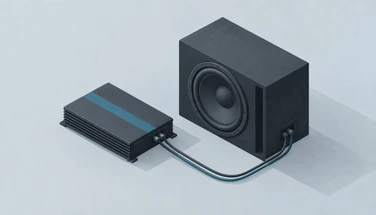
A subwoofer and amplifier pairing. The sub and amp are chosen so their power and impedance ratings agree. This is the core of any combo. The enclosure and wiring may or may not be included.
A full bass package. Sub, amp, enclosure and an installation kit. According to a professional car audio publication, subwoofer upgrade packages from car stereo shops typically include a 200 to 300 watt amplifier, a single subwoofer, an enclosure and an installation kit, and most use a 12-inch sub in a sealed enclosure.
A powered (amplified) subwoofer. The amp is built into the enclosure. It is compact and simple, but you cannot change the amp-to-sub relationship later.
A wiring kit sold as a “kit.” One guide to amplified subwoofers points out that a car subwoofer kit can mean either a sub-plus-amp package or a wiring kit with power cable, ground cable, fuse holder, remote turn-on wire and RCA cables. Read the contents list so you know whether you are buying bass hardware or only cable.

A quick contents checklist
Before you add any package to your cart, confirm these line by line:
- Subwoofer model, size and voice coil configuration (single or dual, 2-ohm or 4-ohm).
- Amplifier model, with its RMS output listed at specific impedances.
- Enclosure type (sealed, vented or a custom pod) and its internal volume.
- Wire gauge and length, fuse holder, ground cable, RCA cables and remote lead.
- Whether you need a bass knob or a line output converter for your factory radio.
If something is missing, add it deliberately. A package that leaves out the wiring is not a bargain if you have to buy it separately anyway.
How to match an amp to a subwoofer
Matching is a comparison of numbers printed in the product manuals. Three of them matter.
1. RMS power
RMS is continuous power. It tells you what the sub can take hour after hour without distortion or damage. A manufacturer’s spec sheet guide advises matching the sub’s RMS rating to the amplifier’s RMS output. Peak, max and dynamic figures are marketing numbers. Leave them out of the equation.
In practice, aim for an amp that delivers its rated RMS at the impedance you will actually present to it, at or a little above the sub’s RMS rating. A cleanly powered sub is happier than an underpowered one pushed into distortion.
2. Final impedance
Impedance is the electrical load the sub puts on the amp, measured in ohms. Common values are 2 and 4 ohms. It is the number people skip, and it is the one that can hurt the amp.
One amplifier owner’s manual states a minimum speaker impedance of 2 ohms in stereo and 4 ohms in bridged mono for its amps, and warns that going lower sends the amp into protection and may damage its electronics. Every amp has its own stable-load rating, so read yours.
Dual voice coil subs add a wiring choice. As BestCarAudio explains, with dual 2-ohm coils an installer can wire the subs to present a 2-ohm or a 0.5-ohm load, and the publication recommends skipping the 0.5-ohm option because it means more distortion and less amplifier efficiency.
3. Power at that exact load
An amp does not make one wattage. A model might be rated at 500 watts at 4 ohms and 800 at 2 ohms. The number that counts is the one at your final load. Work it like this:
- Wire the sub(s) on paper and write down the final impedance.
- Find the amp’s continuous RMS rating at that impedance, in the mode you will use (stereo or bridged mono).
- Compare it to the sub system’s combined RMS rating.
Do not mix unlike subwoofer models, power ratings or coil impedances on one amp channel. It makes the load unpredictable.
A worked example
Say you pick a single dual 2-ohm sub rated at 500 watts RMS. You wire its coils in parallel for a 1-ohm load or in series for a 4-ohm load, depending on the amp. If your mono amp is stable at 2 ohms and the sub is a dual 4-ohm model wired in parallel, you land at 2 ohms. You then look for an amp that delivers roughly 500 watts RMS at 2 ohms. An amp that only makes 500 at 4 ohms and 300 at 2 ohms would leave the sub underfed once wired for 2 ohms, and a bigger model is the better match.
The same logic applies to demanding subs. One review of a 10-inch competition-style sub rated at 400 watts RMS per sub recommends a dedicated amp delivering a clean 800 watts RMS at the final load for a two-sub setup, and cautions that clipping is what most often kills subs. Clean headroom is the goal.
Sealed or vented, 10 or 12 inch: what suits your vehicle
Size and enclosure decide how the combo sounds and whether it fits.
| Choice | What you tend to get | Good fit for |
|---|---|---|
| Sealed enclosure | Tight, controlled bass, smaller box | Rock, country, accurate music, limited space |
| Vented (ported) enclosure | More output around the tuning frequency, bigger box | Hip-hop, EDM, louder bass |
| 10-inch sub | Quick response, compact | Sedans, coupes, small trunks |
| 12-inch sub | Deeper, fuller low end | Trucks, SUVs, hatchbacks with room |
The tradeoffs are not always what people expect. BestCarAudio’s Dave MacKinnon notes that a 10-inch sub in a vented enclosure can produce about 3 dB more output from 40 to 50 hertz than a 12-inch sub in a sealed enclosure for a similar investment. It does so with less power, so the amp runs cooler and draws less current from the electrical system. If your car has a modest charging system, that is worth knowing.
A box that is too large for your trunk is one of the most common package regrets. Measure the cargo space you are willing to give up, including the clearance for a folding rear seat if you use it, before you pick an enclosure. Speaker pods and custom-fit enclosures exist for tighter vehicles.
Wiring and electrical checks before you install
The combo is only as good as the power feeding it. These checks apply to nearly every amp install.
Check the voltage first. Amps are designed to work within a 9 to 16 volt DC range, and the manufacturer’s manual says to verify supply with a voltmeter before connecting wires: the battery should read at least 12 volts with the ignition off. A battery that reads low needs attention before you add load.
Fuse near the battery. The same manual says the inline fuse or circuit breaker must sit as close to the battery’s positive terminal as possible, no more than 18 inches away, to prevent fire risk if the power cable shorts. A Boston Acoustics amplifier manual repeats the 18-inch limit and recommends 4-gauge wire for that amp series. Always follow your own amp’s manual for gauge and fuse rating.
Evaluate the battery and alternator. The Boston Acoustics manual advises thoroughly evaluating the battery and alternator before installing an amplifier, so they can handle the added demand. A bigger amp pulls more current at full tilt. Heavy-duty alternators and batteries exist for a reason, and a system with a large amp is where they matter.
Size the power wire to the current and length. Longer runs and higher current need thicker cable. For high-current installs, oxygen-free copper is generally the preferred conductor, so be wary of a cheap kit that skimps on gauge.
Ground it well. A good ground is short, properly sized and bolted to a suitable low-resistance point on bare metal. Poor grounds cause voltage drop, noise, heat, protection mode and reduced performance.
Give the amp air. Do not bury it under carpet or cargo. Amps make heat, and ventilation keeps them from throttling back or shutting down.

Reading bundle deals and package prices
Searches for subwoofer bundle deals and car subwoofer package deals are really a search for matched parts at a sensible total. Here is how to judge one.
- Count what is in the box. Compare the package to buying the sub, amp, enclosure and wire kit separately, using the same list of components.
- Check the headroom. A guide to subwoofer kits notes the usual tradeoffs: a package may include an enclosure that is too large for some vehicles, or amp power that is adequate now but limited for future upgrades. Ask whether the amp leaves room to grow.
- Compare RMS to RMS. Two bundles with the same advertised “watts” can be far apart once you look at RMS at the final impedance.
- Know your car. A bundle designed for a truck cab may not suit a compact trunk.
- Ask about financing and returns up front. If you plan to spread out the cost, check the terms on the checkout page of whichever store you use, as they vary by seller.
Our perspective on combos
Most of the bass problems we hear about come down to mismatched parts. A great sub on an amp that is too small clips. A great amp on a sub with the wrong impedance runs hot or cuts out. Nobody lacks good gear. They lack a plan that ties it together.
That is why we start with your vehicle and your goal. Daily driver who wants fuller bass that still sounds musical? A different build than a competition setup. We pair subwoofers, amplifiers, enclosures, wire and electrical parts so the whole system works, and our team includes real installers who talk it through with you before you buy.
We also look past the amp and sub. Alternators, batteries and wiring are part of what we sell, because the electrical side is where many systems fall short. If you are building something bigger, custom battery builds and recone services are available too. A combo should be something you set up once and enjoy for years, not something you redo.
Colten
Build a matched system with Crystal Audio Solutions
If you would rather not do the matching math alone, we do it with you. Tell us your vehicle and what you want from your bass, and we recommend subwoofers, amplifiers, enclosures, wire and electrical parts that work together, with compatibility checked before you buy.

Use Build My System to start from your vehicle and goals, or browse our subwoofers, amplifiers, alternators, batteries, wire, subwoofer enclosures and speaker pods on the Crystal Audio Solutions store. Automatic bundle savings and flexible payment options help the build fit your budget.
A simple way to choose your combo
Work through these in order and the choice usually narrows quickly.
- Set the goal. Fuller everyday bass, loud street bass, or competition? This picks your power class.
- Set the space. Measure the trunk or cab area you will give up. This picks the enclosure and sub size.
- Pick the sub, then the amp. Choose the sub for your goal, then the amp whose RMS at your final impedance matches it.
- Plan the wiring. Choose gauge and length for the amp’s current draw, plus the fuse and ground.
- Check the electrical system. Test the battery, and consider an upgraded alternator or battery for big builds.
- Confirm the contents. Match the package list to the checklist above before you check out.
FAQ
Can I run a subwoofer without an amplifier?
Not a car subwoofer built for an external amp. Most car subs need far more power than a head unit provides, and one review of a power-hungry 10-inch model says you cannot expect results from a head unit or a tiny 100-watt amp. Pair it with an amp rated for the sub’s RMS at the final impedance, or choose a powered enclosure that has the amp built in.
Is a bigger amp always better for a subwoofer?
No. What matters is clean power at the right impedance, close to the sub’s RMS rating. An amp far over the sub’s rating risks damaging it if the gain is set too high, and a badly underpowered amp risks clipping. Match RMS to RMS and set the gain carefully.
Do I need a new battery or alternator with an amp and sub combo?
It depends on the size of the amp and the condition of your current parts. The Boston Acoustics manual advises evaluating the battery and alternator before installing an amplifier. For larger systems, a stronger alternator and battery help keep voltage steady during loud passages.
Is it cheaper to buy a package or separate parts?
Often a package is simpler and saves money, because the parts are already matched. Compare the contents line by line, including the enclosure and wiring. Ask us about automatic bundle savings and we can tell you what applies to your build.
What size subwoofer should I choose for my car?
Choose by space and music taste. A 12-inch sub in a sealed box is the common entry-level pairing, while a 10-inch in a vented box can deliver more output in the 40 to 50 Hz range with less power. Smaller vehicles often do better with the 10-inch and a compact enclosure.
Sources
- Buying an Entry-Level Car Audio Subwoofer System? Read This First (BestCarAudio)
- 7 Key Criteria for Selecting the Right Sub Amp (BestCarAudio)
- Amplifier owner’s manual (PowerBass USA, 2025)
- Product manual (Boston Acoustics)
- Subwoofer Specifications Explained: RMS, Xmax and Impedance (American Bass USA)
- Car Amplified Subwoofer Guide: Powered Enclosures and Amps (Sparrow Car)
- Kicker 10 Inch Comp R Subwoofer Review (SonicMetric)
Written with BabyLoveGrowth to rank on Google and in AI search