
Posted by Cas on Nov 8th 2026
Custom Speaker Pod Fit Guide
Custom Speaker Pods: How to Choose, Fit and Install Them

Custom speaker pods are vehicle-specific mounting housings that give a speaker a finished, solid home where the factory opening is too small, too shallow or in the wrong place. The right pod depends on three things: your vehicle’s year, make, model and body style, the location you want to use (door, A-pillar, kick panel, rear deck), and the exact dimensions of the speakers you plan to mount. Get those three aligned and the install is clean. Get one wrong and you end up with a speaker that rubs, rattles or won’t fit.
This guide walks through what pods do, how they differ from a generic speaker box, how to read fitment specs, what to check during installation, and when you need speaker rings instead.
TL;DR
- Pods let you run larger or additional speakers than the factory location allows, with a clean, finished look and far less fabrication than building from scratch.
- A pod is a small enclosure, so size it to the speaker. Low-frequency drivers need real baffle or enclosure volume, while small mids and tweeters are far more forgiving.
- Before you buy, compare the speaker’s outside diameter, cutout, mounting depth and magnet or basket clearance with the pod’s listed specs.
- Test fit everything before you drill or cut, and tighten hardware snug, not hard.
- Speaker rings and spacers solve depth and bolt-pattern problems. Water-resistant plastics beat wood in car doors.
Table of Contents
- What custom speaker pods actually do
- Speaker pods versus a 6.5 speaker box
- How to choose door speaker pods that fit
- Installing custom door speaker pods
- Custom speaker rings: when you need them
- Matching pods to your goals
- Perspective
- Get the whole system to match
- Common mistakes to avoid
- FAQ
- Sources
What custom speaker pods actually do
A factory door speaker location is built around a cheap, shallow, usually 6.5-inch or smaller paper cone. When you move to a better speaker, three problems show up quickly: the new speaker is bigger, it sits deeper, or the bolt pattern doesn’t line up. Pods answer all three.
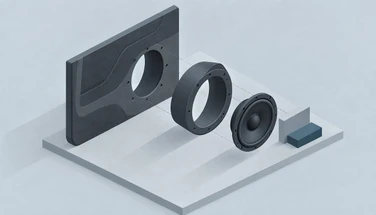
A pod is a formed housing that mounts to a flat or prepared area of the vehicle and holds the speaker at a specific size and angle. In practice, a good pod gives you:
- A finished foundation. The speaker sits in a shaped, rigid mount instead of a hole you cut and hope for the best.
- More locations. You are no longer limited to the factory opening. Doors, A-pillars, kick panels and rear decks all become options.
- More size choices. Larger drivers or multi-speaker layouts, such as a 6.5-inch with a tweeter or a dual-woofer arrangement, become practical.
- Less fabrication. Compared with hand-building fiberglass or MDF enclosures, a vehicle-specific pod removes most of the shaping, resin work and finishing.
Those points track how pod makers describe their purpose, and they match what installers see on the bench: the pod does the awkward geometry so the speaker can do its job.
Why does bigger matter? A larger cone moves more air. More cone area means more potential output, especially in the midbass, which is where factory systems feel thin.
Door, A-pillar, kick panel and rear deck
Where you put the pod changes how the system sounds and how hard the install is.
- Door pods are the most common upgrade. Doors give you the biggest openings and the most depth, so they suit midbass and full-range 6.5-inch to 8-inch drivers. Door pods also tend to be the simplest to plan because the factory location is already close to where you want the speaker.
- A-pillar pods are typically for tweeters and small midrange drivers. Their small size is a feature here, since high-frequency drivers don’t need much volume. They aim sound toward the listener and help with imaging.
- Kick panel pods put the speaker low and forward, closer to the footwell. Some installers favor this spot because it can pull the soundstage toward the center of the car. One long-running installation guide argues that kick panels are closer to the balanced ideal of a home stereo, because we are more sensitive to left-right location than up-down. Treat it as one installer’s view, not a rule.
- Rear deck pods hold larger drivers behind the rear seats in many sedans and coupes, and work well for fill or for extra output.
Speaker pods versus a 6.5 speaker box
People searching for a “6.5 speaker box” are usually after one of two things: a pod that holds a pair of 6.5-inch speakers, or a sealed or ported enclosure for 6.5-inch drivers. The difference matters.
A pod is, in effect, a small enclosure. It is shaped to your vehicle and designed mostly to mount and position the speaker. A speaker box is a more generic container. It is sized by internal volume and tuned for a specific driver and frequency range.
Here is how they compare in practice:
| Vehicle-specific pod | Universal speaker box | |
|---|---|---|
| Main job | Mount and aim a speaker in a particular spot | Contain a driver and control its low-frequency behavior |
| Fit | Shaped for a year, make, model and location | Generic shape, you adapt it to the vehicle |
| Install effort | Low to moderate | Moderate to high, with more trimming and finishing |
| Best for | Midrange, tweeters and midbass in doors or pillars | Standalone placements where you have space and want to control volume |
| Watch out for | Matching speaker depth and diameter to the pod | Where it physically goes, and how it affects trunk or cabin space |
Why pod size matters for bass
Low frequencies are the sticking point. According to one car audio publication, speakers playing below about 300 Hz need to be on a baffle or in a large enough enclosure. It specifically calls out tiny A-pillar pods for 4-inch speakers playing down to 150 Hz, and small kick-panel pods for 6.5-inch speakers trying to reach 80 Hz, as setups that don’t work.
The takeaway is simple and useful:
- Match the pod to the job. Small pods suit tweeters and mids that are filtered to play higher.
- If you want real midbass from a 6.5-inch driver, mount it in a door, where the door cavity and baffle help, or in a pod designed for that driver.
- Don’t force the biggest driver into the smallest pod just because it bolts in.
If you plan to hand deep bass to a subwoofer and filter your door speakers to play higher, pod size becomes much less of a limit. That is why a balanced system plan starts with what each speaker is supposed to play. Our guide on planning a car audio upgrade covers that order of operations.
How to choose door speaker pods that fit
Door speaker pods are the most searched pod type, and fitment is where most buyers get stuck. Use this order.
Step 1: Confirm the vehicle
Write down the year, make, model and body style. A crew cab and an extended cab can have different door panels. A coupe and a sedan of the same model often do too. Generation changes matter: a 2008 and a 2011 of the same nameplate can share a name and not a door.
Step 2: Choose the location and speaker layout
Decide what you want the pod to hold before you shop. Common layouts include:
- A single 6.5-inch speaker
- A 6.5-inch speaker plus a small tweeter
- Dual 6.5-inch speakers stacked
- An 8-inch speaker with a tweeter
- A dual tweeter pod for pillars
Your goal drives the choice. A daily driver who wants clearer vocals needs a different layout than a competition builder chasing output.
Step 3: Compare the speaker specs to the pod specs
This is the step that prevents returns. Pod makers generally publish specs for the speakers a pod will take, and good guidance is to compare the speaker’s cutout, frame diameter and mounting depth with them. Pull the numbers from your speaker’s manual or spec sheet and check each one:
- Outside diameter of the frame (OD). The speaker’s outer basket or flange must fit within the pod’s maximum.
- Cutout diameter. The hole the speaker needs must match or be smaller than what the pod provides.
- Mounting depth. How far the speaker body extends behind the mounting surface. This is the most commonly missed number.
- Basket and magnet clearance. Large magnets and baskets can foul on the pod or on the door’s internal bracing.
- Tweeter housing size. Check the diameter and depth of the tweeter housing separately from the main driver.
The depth limit in a shallow pod is often the deciding factor. A speaker with a big motor can have excellent specs on paper and still not fit.
One more reminder: because pods are made for a particular vehicle and layout, they may be non-returnable once ordered in a custom configuration. That is a reason to measure twice, not a reason to guess.
Step 4: Match the pod to the rest of the system
A pod only changes where and how the speaker mounts. The speaker still needs the right power. If you move up to larger drivers, check that your amplifier can supply the wattage and that your wiring is up to it. This mismatch is the most common reason a good speaker upgrade sounds disappointing.
Installing custom door speaker pods
A vehicle-specific pod is designed to go in with common hand tools, without resin, fiberglass or body filler. The installation approach from the pod manufacturers is straightforward and worth following in this order:
- Test fit everything first. Hold the pod and the speaker in place before any drilling or cutting. Check that the door window travels freely and the door panel still closes over the pod.
- Mark and drill the mounting holes. Use the pod itself as the template, and mark only after you are happy with the position.
- Trim only where needed. Remove panel material only where you need clearance for the speaker, and follow the pod’s instructions on where that is.
- Mount with the supplied hardware. Tighten until snug. Overtightening can crack plastic or distort the mounting surface, which creates buzzes.
Extra checks that save time
- Window and regulator travel. With the pod mounted and the speaker in place, run the window all the way up and down before reassembling the panel.
- Wiring slack. Leave a little slack so the speaker lead doesn’t strain at the terminal when the door opens and closes.
- Moisture. Doors get wet inside. Keep speaker wires and any exposed materials away from the water path, and don’t block the door’s drain holes.
- Rattles. Press on the finished panel while the system plays a bass-heavy track. Anything that buzzes now will buzz louder on the road.
If you are not comfortable removing door panels and working around airbag wiring or window electronics, a professional installer is the safer choice. Door panels in many modern vehicles hide connectors and clips that break easily.
Custom speaker rings: when you need them
Speaker rings, also called mounting adapters or spacers, are simpler than pods. They are for situations where the factory opening is basically right but something small is off. You typically need them when:
- The new speaker is deeper than the factory unit and needs spacing to clear the door’s inner structure or the window
- The original mounting holes don’t match the new speaker’s bolt pattern
- You want to angle or lift the speaker slightly toward the listener
A ring does not add cone area, so it is not a substitute for a pod when you want to go bigger. It is the right fix when the opening is the right size and the problem is only depth or pattern.
What to make them from
Material matters more than most people expect. A trade publication on mounting adapters notes that professionals use materials like ABS, HDPE, expanded PVC, cast acrylic and Corian, specifically to avoid the water damage and mold that come with wood. The same article describes an installer who found a set of premium speakers that had broken after being mounted to wooden rings with the wrong screws.
In a door that sees rain, condensation and car washes, choose a water-resistant plastic ring and use the correct screws for the speaker and the material.

Matching pods to your goals
The best pod depends on what you want from the system.
Daily driver, better sound. Choose a pod for a quality 6.5-inch speaker in the door, plus a tweeter if the pod offers one. Keep it simple. A clean door install with a properly powered pair of speakers beats a complicated layout every time.
Enthusiast building a balanced system. Think in roles. Let a subwoofer cover the deep bass, use door pods for midbass and midrange, and place tweeters where they can aim toward you. Filter each speaker to the range it handles well.
Competition builder. More cone area and more output are the priority, so larger drivers and multi-speaker door or rear deck pods make sense. You will care most about mounting rigidity, depth clearance and being able to repeat the install precisely.

Budget-conscious buyer. A pod is often a lower-cost route than hand-built fiberglass, and it lets you upgrade in stages. Start with front door pods and speakers, then add an amplifier and subwoofer later. Financing options can also spread the cost of a full build.
Perspective
Most speaker upgrades that disappoint don’t fail because the speaker was bad. They fail because something in the chain didn’t match: a speaker too deep for the pod, an amplifier too small for the driver, or a pod asked to do a job its size can’t support.
That is why we start with your vehicle and your goal, not with a product. We verify compatibility before you buy, and we pair pods and enclosures with the speakers, amplifier and wiring that belong with them. Our team includes real installers, so the advice you get comes from people who have fit these parts in actual doors and pillars.
If you are choosing between a pod and a generic box, our view is simple: use the pod when you want a clean, vehicle-specific mount and the box when you need controlled volume. Tell us which spot you’re upgrading and what you want to hear, and we will build the plan around that.
Colten
Get the whole system to match
Speaker pods work best as one piece of a planned system. We sell speaker pods, subwoofer enclosures, subwoofers, amplifiers, alternators, batteries and wire, and our Build My System service matches the parts to your vehicle and your goals before you order. If you are not sure which pod, speaker or amplifier fits together, start with our car audio catalog and tell us what you drive.

We also offer custom battery builds and recone services for people who want to rebuild or push a system further.
Common mistakes to avoid
- Buying by speaker diameter alone. A 6.5-inch speaker is not a standard size in every dimension. Depth and magnet size vary a lot.
- Ignoring the door’s inside. Window tracks, regulators and bracing limit how deep anything can go.
- Putting a woofer in a tweeter pod. Pod volume has to suit the frequencies the speaker plays.
- Skipping the test fit. Drilling first and checking later is the most expensive way to learn a measurement was off.
- Overtightening. Snug is enough. More force cracks plastic and causes rattles.
- Using wood in wet locations. Choose water-resistant plastics for any ring or spacer that lives in a door.
FAQ
Are custom speaker pods better than building fiberglass pods?
For most installs, vehicle-specific pods are the faster and tidier route, because the shaping is already done and they bolt in with common tools. Fiberglass still makes sense for one-off designs that no premade pod covers. Either way, the speaker, amplifier and wiring matter just as much as the housing.
Can I put a 6.5-inch speaker in any door pod?
No. Check the speaker’s outside diameter, cutout, mounting depth and magnet clearance against the pod’s specs. Pods are designed for a particular range of speaker sizes, and depth is the number buyers most often miss.
Do speaker pods improve bass?
They can help by letting you mount larger drivers with more cone area. But low frequencies need enough baffle or enclosure volume, so very small pods are best used for midrange and tweeters. A subwoofer handles the deepest notes.
What is the difference between a speaker ring and a speaker pod?
A ring is a spacer or adapter that fixes depth or bolt-pattern problems in an existing opening. A pod is a formed housing that can create a new mounting location or hold a larger speaker. Use a ring when the opening is right, and a pod when it isn’t.
Can I return custom speaker pods?
Customized products may not be returnable, so confirm your vehicle details and speaker dimensions before ordering. If you are unsure, ask us to check compatibility first.
Sources
- Proper Car Audio Speaker Installation and Mounting Adapters, Best Car Audio
- 6x9 Speaker Boxes: Convenience or an Epic Fail?, Best Car Audio
- Car Speaker Placement and Kickpanels, Car Audio Help
- What are Custom Speaker Pods?