
Posted by Cas on Nov 13th 2026
Car Audio Battery Isolator: What It Does and When to Use One
Car Audio Battery Isolator: What It Does and When to Use One

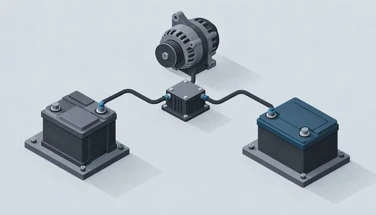
A car audio battery isolator is a switch, relay or diode that joins your starting battery and a second audio battery while the engine runs, then separates them when it stops. That way a long listening session can drain the audio battery without leaving the car unable to start. You need one if you play music with the engine off or run a second battery. You don’t need one if you only listen while driving. The right type depends on your battery chemistry, your alternator and your amp load, which is why we plan those parts together on every system we build.
TL;DR
- An isolator protects the starting battery. It doesn’t add power or make the system louder.
- Add one if you play music with the engine off for long stretches or run a dedicated second battery. Skip it if you listen only while driving.
- Match the type to the batteries: a relay (voltage-sensitive relay, or VSR) for two similar lead-acid or AGM batteries, a DC-DC charger for lithium or mixed chemistries.
- Rate the isolator at or above your alternator’s output, and fuse every positive run close to each battery.
- If voltage sags while you drive, the fix is the alternator and the heavy wiring, not a second battery.
Table of Contents
- What a battery isolator does
- Do you need a battery isolator?
- Types of isolators and how they differ
- How to choose the right rating
- Wiring and safety basics
- Common mistakes
- Where the rest of the electrical system fits
- Perspective
- Plan the whole system with Crystal Audio Solutions
- FAQ
- Sources
What a battery isolator does
A car has one battery, charged by the alternator, and everything draws from it: the starter, the lights, the ECU and your amplifier. A big system can pull more current than the alternator makes at idle, and a long engine-off session can run the battery down until the car won’t crank.
A second battery gives the audio system its own supply. The problem is what happens if you simply wire the two together. Eaton Bussmann’s battery isolator product profile explains it: when a fully charged battery is connected to a partially discharged one, current flows between them until they reach a common charge level. That can discharge both and keep the engine from starting.
The isolator fixes this by acting like a check valve. According to the same Eaton profile, accessories can draw from the auxiliary battery without touching the starting battery, and while the engine runs the alternator charges both. Each battery then works as an independent power source.

The picture to keep in mind is a car show. You park, run the system for an hour with the engine off and shut it down. With isolation, only the audio battery is drained. The starting battery is untouched and the car still cranks.
One point sets expectations. An isolator is a protection and charge-control device. It adds no electrical power, and some designs reduce the voltage that reaches the second battery slightly.
Do you need a battery isolator?
It comes down to how you listen.
You probably need one if:
- You play music with the engine off for long periods, at shows, tailgates or in a parked car.
- You run a dedicated second battery in the trunk or rear of the vehicle.
- Your starting battery has to stay healthy for the daily commute no matter what the system does.
You probably don’t need one if:
- You listen only while driving. Lifewire’s guide to a second battery for car audio says a second battery is mainly worthwhile if you listen with the engine off. With the engine running, it is one more load the alternator has to refill.
- You want a bigger buffer for short bass hits. Batteries wired directly in parallel can serve that purpose without an isolator, because the aim there is quick current delivery rather than separate starter and audio supplies.
The rule is simple. If the starting battery must be protected from the audio load, use isolation. If both batteries are only there to cushion brief power peaks, a straight parallel connection is the simpler build.
A second battery won’t fix a weak charging system
A lot of enthusiasts add a battery and an isolator hoping to cure dimming headlights or a bass note that sags. A second battery adds capacity and smooths short dips. It can’t create output the alternator doesn’t make. A discharged second battery can even overtax the alternator and make dimming worse, as the Lifewire guide notes.
So test first. If voltage drops steadily while you drive at cruising RPM, the limit is charging capacity or the cable path. Fix that before adding batteries. Our car audio wire gauge guide covers the power and ground cable sizes, and our car audio upgrade guide shows where the electrical work sits in the order of upgrades.
Types of isolators and how they differ
Three device families do the job. Each suits a different build.
| Type | How it works | Best for | Watch for |
|---|---|---|---|
| Diode isolator | Diodes pass current one way only | Simple builds, high current | Fixed voltage drop, so the second battery charges to a slightly lower voltage |
| Relay / VSR (voltage-sensitive relay) | Closes when charging voltage appears, opens when it falls | Two lead-acid or AGM batteries of similar type | May not work properly with alternators controlled by the vehicle computer |
| DC-DC charger | Actively regulates the charge sent to the second battery | Lithium, mixed chemistries, computer-controlled alternators | Current is limited to the unit’s rating |
Diode isolators
A diode isolator has no moving parts, which makes it robust. The trade-off is voltage. Each diode drops a fraction of a volt, so the audio battery never reaches the voltage the alternator produces. For an amplifier that means a little less headroom, and the second battery won’t charge fully. It works, but it isn’t the best fit when you chase every tenth of a volt.
Relay or voltage-sensitive relay
A VSR senses voltage at the starting battery. When charging voltage shows up, it closes and joins the batteries. When voltage falls after shutdown, it opens. Contact drop is minimal, so the audio battery charges close to full voltage. This is the usual choice for two lead-acid or AGM batteries.
If you build your own relay-based isolator, the coil draw matters. Pacific Accessory’s PAC-200 instructions show what a purpose-built mobile audio relay looks like. It is rated for 200 amperes continuous at 12 volts and 300 amperes surge, switches between 10 and 16 volts, draws under 1 ampere through the coil, and calls for fuses placed as close to the batteries as possible. A general-purpose automotive starter solenoid isn’t designed for continuous duty, so choose a continuous-duty part.
DC-DC chargers
Modern vehicles often control the alternator through the engine computer, which can lower output once it sees a full starting battery. A relay that waits for charging voltage can then behave unpredictably. A DC-DC charger solves this because it draws from the starting side and delivers a regulated charge to the second battery. It is also the right tool when the second battery is lithium and the starter battery is lead-acid, since the two want different charge profiles.
There is a limit: the charger can only move as much current as its rating, and it can’t create alternator capacity that isn’t there.
How to choose the right rating
Three numbers decide the choice.
- Alternator output. Read the spec plate on the alternator. For relay or diode isolators, pick a rating at or above that figure, and make sure the cable and fuse sizes you use are within the limit of the device.
- Battery chemistry. Two matching lead-acid or AGM batteries point to a relay. Lithium or mixed chemistries point to a DC-DC charger. For direct parallel connections, use batteries of the same type, brand, age and condition whenever possible.
- Charge rate you want. A DC-DC charger is sized to the charging current you want and the surplus your alternator can provide, which is often a few dozen amps rather than the full alternator output.
An example: a car has a 200-amp alternator and a pair of AGM batteries, one under the hood and one in the trunk. A relay rated for 200 amps continuous, such as the PAC-200 class above, covers the alternator output. If the second battery were lithium, a DC-DC charger sized to the surplus current would be the better match.
Check the alternator and batteries first
Before you buy any isolator, confirm four things:
- Alternator capacity. What does the plate say, and how much of that is free after the car’s own loads?
- Alternator control. Some vehicles let the computer lower output at full battery voltage. On those, a relay may not behave, and a DC-DC charger is the safer path.
- Battery charge acceptance. AGM and lithium accept charge differently, so the chemistry sets the device.
- Cable runs. The distance from alternator to each battery sets the wire gauge.
Build year alone doesn’t tell you whether a vehicle is compatible. Checking the actual parts does. It is the reason we verify compatibility before an order ships, which is covered below.
Wiring and safety basics
The wiring decides whether an isolator protects the car or becomes a fire risk. These are the points that matter.
- Fuse every positive run close to each battery. A fuse within about 18 inches of the battery is standard practice. The fuse protects the wire, so its rating must not exceed what the wire can carry.
- Size cable for current and length. Eaton’s profile and the PAC-200 manual both stress that all power should flow through the battery-side fuses. Our wire gauge guide lists sizes by current and run length.
- Upgrade the Big 3 when output is high. The Big 3 are the alternator-to-battery positive, battery negative to chassis and engine block to chassis cables. Upgrading them improves current flow, and it comes before adding a second battery if voltage sags.
- Keep grounds short and solid. Bond the battery negative to bare chassis metal and keep the path short and clean.
- Buffer the trigger. A relay coil draws more current than a head unit’s remote output can supply, so the trigger should come from an ignition-switched source or through a small relay, not directly from the head unit.
- Ventilate and secure the battery. A battery inside the passenger area should be a sealed type. A trunk battery should be secured and vented, since charging can release flammable gas.
If you aren’t sure about any step involving the main power cable, have an experienced installer do the work. A mistake there carries fire risk.
Common mistakes
Expecting more volume. Isolators protect. They don’t boost. If the aim is a louder system, start with the amp and subwoofer match. Our amp and subwoofer matching guide walks through it, and our piece on what makes a car stereo play louder covers the rest of the chain.
Mixing chemistries on a relay. A lithium second battery on a relay built for lead-acid doesn’t get the charge profile it needs. Use a DC-DC charger.
Buying by price alone. A cheap isolator that is under-rated for your alternator overheats or limits current. Rate it to the alternator first.
Skipping fuses. Without a fuse near each battery, a short on the cable becomes a direct short on the battery.
Ignoring the real bottleneck. A system that runs out of voltage while driving needs alternator capacity and heavy cables. More batteries won’t solve it.

Where the rest of the electrical system fits
An isolator is one part of a power plan that also includes the alternator, the batteries and the cables. Each piece depends on the others. A bigger alternator with thin cables still starves the amp. A second battery on a weak alternator never fully recharges. The best results come from sizing them together around your goal, whether that’s a clean daily-driver upgrade or a competition build.
That’s the logic behind the way we sell. Our catalog covers subwoofers, amplifiers, alternators, batteries, wiring kits, enclosures and speaker pods, so the parts that carry power and the parts that use it come from one place and are checked against each other. Direct support from real installers, plus compatibility verification before purchase, is our answer to the common problem of mismatched components.
Perspective
Most of the electrical questions we hear start with a part: which isolator, which battery, which relay. The better question is what the system is supposed to do. A daily driver that plays loud on the commute needs good cable and a healthy alternator. A show car that sits in a lot with the engine off needs a second battery and a way to keep it separate. A competition build may need both, plus more current than a stock charging system can give.
We build recommendations from the vehicle and the goal, then match the amplifier, the batteries, the alternator and the wire to each other. That is what stops the usual mismatch, where each part is fine alone and the system as a whole underperforms. An isolator belongs in that plan when the use calls for it, and we would rather you know why it is there than add it because a forum said so.
If you want the whole chain checked before you buy, that’s what Build My System is for. And if you’re not sure whether your car needs isolation at all, tell us how you listen and we’ll work it out with you.
Colten
Plan the whole system with Crystal Audio Solutions
If you’re adding a second battery, upgrading an alternator or stepping up to a bigger amplifier, the compatible way to do it is as one plan. Through Build My System, you tell us your vehicle and your goals. We recommend matched subwoofers, amplifiers, batteries, alternators and wire, and we verify compatibility before you buy. Financing options and automatic bundle savings are available to keep the build within your budget.

You can browse the full range of subwoofers, amplifiers and electrical parts on our site. We also offer custom battery builds and recone services for advanced or rebuild projects.
FAQ
Do I need a battery isolator for car audio?
Only if you want to protect the starting battery from the audio load, for example when you play music with the engine off or run a dedicated second battery. If you listen only while driving, you generally don’t need one. The batteries can also be wired in parallel when they only serve to cushion brief power peaks.
Will a battery isolator make my system louder?
No. It controls how the batteries are charged and separated, and it doesn’t add power. Some types reduce the voltage reaching the second battery slightly. For more output, look at your amplifier, subwoofer match, wiring and alternator capacity.
What is the difference between an isolator, a VSR and a DC-DC charger?
A diode isolator passes current one way and drops a little voltage. A voltage-sensitive relay joins the batteries when charging voltage is present and separates them when it falls. A DC-DC charger regulates the charge delivered to the second battery, which makes it the right choice for lithium, mixed chemistries and computer-controlled alternators.
What size isolator do I need?
Choose a rating at or above your alternator’s output, and keep your cable and fuse sizes within the limits of the device. For a DC-DC charger, size it to the charge current you want and the surplus your alternator can supply.
Sources
- Bussmann series Battery Isolator Product Profile No. 10104, Eaton
- Do You Need a Second Battery for Car Audio?, Lifewire
- MODEL PAC-200 instructions, Pacific Accessory